
Tuning Linux for Optimal Worst-Case Task Switch Latency
1. Introduction
Average-case performance is what benchmarks reward. Worst-case latency is what production systems live or die by. A trading engine that switches tasks in 2 microseconds on average but occasionally stalls for 8 milliseconds has not built a fast system — it has built an unpredictable one. The same is true for industrial controllers, telecom base stations, robotics control loops, and audio pipelines: a single missed deadline can mean a dropped packet, a crashed motor, or an audible glitch.
This lesson is about the mechanics of a context switch on Linux — what actually happens between the moment the kernel decides to run a different task and the moment that task executes its first instruction — and about every source of jitter that can insert itself into that path. We will trace the scheduler’s decision logic, the CPU-level cost of switching register and memory contexts, the interrupt and timer subsystems that compete for the same CPU cycles, and the specific kernel knobs, boot parameters, and code patterns that shrink the worst case, not just the average.
By the end, you will be able to reason about a
cyclictesthistogram the way a kernel engineer does, isolate the physical source of a 200-microsecond outlier, and configure a machine — from BIOS tocgroup— for deterministic task switching.
2. Historical Background
Linux was not originally built for determinism. The O(1) scheduler introduced in 2.6.0 (2003) improved average throughput but was notoriously difficult to reason about for latency-sensitive workloads, because runqueue selection involved heuristics that were hard to bound. Ingo Molnar’s Completely Fair Scheduler (CFS), merged in 2.6.23 (2007), replaced heuristics with a red-black tree ordered by virtual runtime — a cleaner model, but still optimized for fairness and throughput, not worst-case bound.
In parallel, a separate lineage began in 2004: the PREEMPT_RT patch set, originally by Ingo Molnar and Thomas Gleixner, aimed at converting Linux into a hard real-time capable kernel. PREEMPT_RT’s central insight was that most sources of unbounded latency in mainline Linux were not the scheduler itself but non-preemptible regions — spinlocks, interrupt handlers, and
bottom halvesthat ran with preemption disabled. PREEMPT_RT converted most spinlocks into preemptible, priority-inheritingrt_mutexes and pushed interrupt handling into preemptible kernel threads.For two decades PREEMPT_RT lived out-of-tree, rebased against every kernel release. It finally merged into mainline in Linux 6.12 (2024), becoming a standard
CONFIG_PREEMPT_RTbuild option rather than a patch series. This matters for tuning: as of 6.12+, the same vanilla kernel source tree can be built asPREEMPT_NONE,PREEMPT_VOLUNTARY,PREEMPT_DYNAMIC(runtime-selectable, default on many distros since 5.x), or fullPREEMPT_RT, each with a fundamentally different worst-case latency ceiling.
3. Systems-Level Problem
“Task switch latency” is really three distinct latencies stacked together, and conflating them is the most common analysis mistake:
Scheduling latency — the time from when a task becomes runnable (e.g., a wakeup from I/O completion or a timer firing) to when the scheduler actually picks it. This includes any time spent waiting behind other runnable tasks, waiting for a currently-running lower-priority-but-non-preemptible section to finish, or waiting for an IRQ/softirq storm to subside.
Context switch cost — the CPU-level cost of saving one task’s register and FPU state and loading another’s, including the TLB and cache effects of switching address spaces.
Dispatch latency — the time from “kernel has decided to return to userspace” to “first user instruction executes,” which includes signal delivery checks, syscall return path work, and any mandatory scheduler bookkeeping (e.g.,
update_rq_clock, load balancing hooks).
The worst case is dominated almost entirely by (1), not (2). A context switch’s CPU cost is typically 1–3 microseconds on modern x86_64 hardware. Scheduling latency, in contrast, is architecturally unbounded on a stock kernel: it depends on interrupt load, RCU grace periods, non-preemptible kernel sections, and even firmware behavior (SMI — System Management Interrupts — can steal the CPU for hundreds of microseconds without the OS even knowing). Tuning for worst-case latency is therefore mostly about eliminating sources of unbounded delay in (1), not optimizing the switch itself.
4. Linux Kernel Architecture
Four subsystems jointly determine task switch latency, and none of them can be tuned in isolation:
The scheduler core (
kernel/sched/core.c,kernel/sched/fair.c,kernel/sched/rt.c,kernel/sched/deadline.c) — implements CFS forSCHED_OTHER, a strict priority scheduler forSCHED_FIFO/SCHED_RR, and the EDF-basedSCHED_DEADLINEclass. Class ordering (deadline > realtime > fair) determines who gets picked first on every reschedule.The interrupt and softirq subsystem — hardware IRQs, threaded IRQ handlers, and softirqs (
NET_RX,TIMER,RCU,SCHED) run with elevated priority over ordinary tasks and can preempt a runningSCHED_FIFOtask unless explicitly configured otherwise (threadirqs, IRQ affinity,PREEMPT_RT‘s forced-threading of hard IRQs).The timer and tick subsystem —
hrtimers, the periodic scheduler tick (scheduler_tick()), andNO_HZ/NO_HZ_FULLtickless configuration determine how often the CPU is interrupted purely for bookkeeping, independent of any real work.
The memory management subsystem — page faults, TLB shootdowns (cross-CPU IPIs triggered by
mprotect/munmapon another core), and transparent huge page compaction can stall a CPU for tens to hundreds of microseconds at unpredictable times.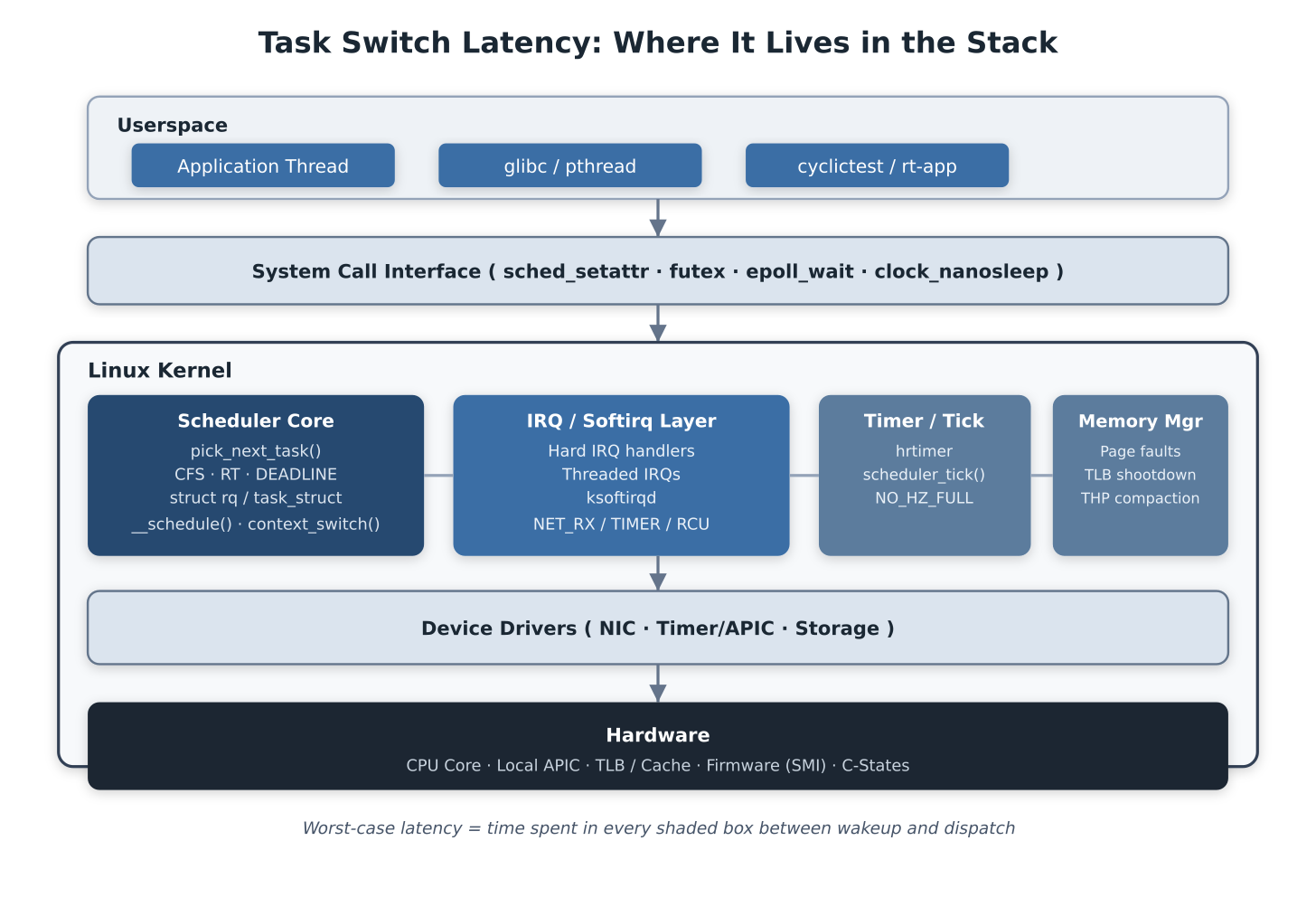
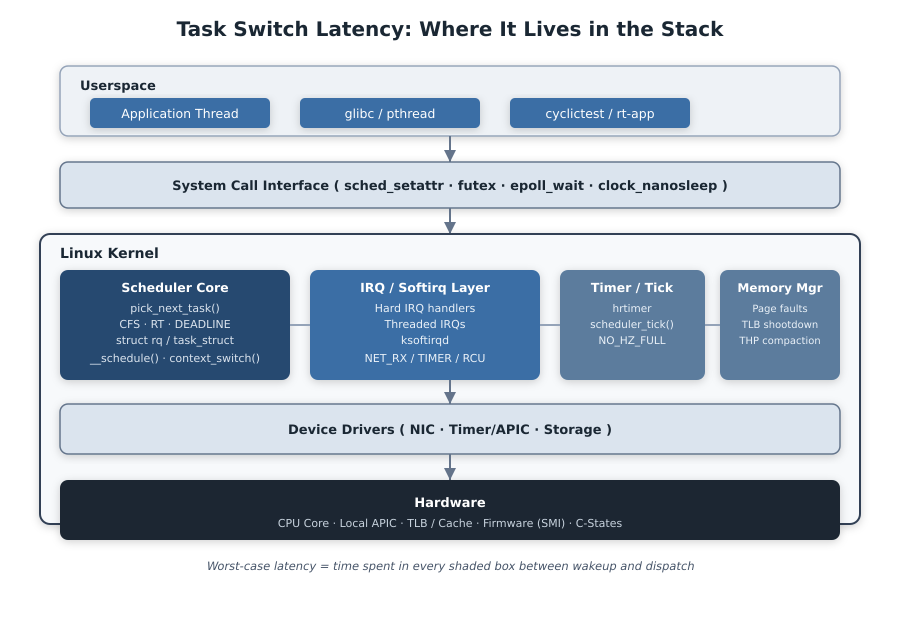
A worst-case-latency tuning exercise is really an exercise in silencing three of these four subsystems (interrupts, tick, and memory management) so that the scheduler’s decision — which is fast and well-bounded once invoked — is the only thing left determining when a task runs.
