DNS Root Server Issues: When the Internet's Foundation Cracks
Alerts flooding your phone. Applications are timing out everywhere. Database connections are failing. Your API gateway shows 50% error rates. The weird part? All your servers are healthy. CPU is fine. Memory is normal. Network bandwidth looks good. Then you check one metric: DNS resolution time. It’s sitting at 15 seconds. Your entire infrastructure is melting down because DNS queries are slow.
Most engineers understand that DNS translates domain names to IP addresses. What they don’t understand is what happens when that translation takes 10 or 20 seconds instead of 10 milliseconds. The failure patterns are subtle, cascading, and devastating. After building systems that handle millions of requests per second, I’ve seen DNS issues take down more production systems than actual code bugs. Let me show you what really happens and how to build resilience into your systems.
The DNS Resolution Chain Nobody Explains
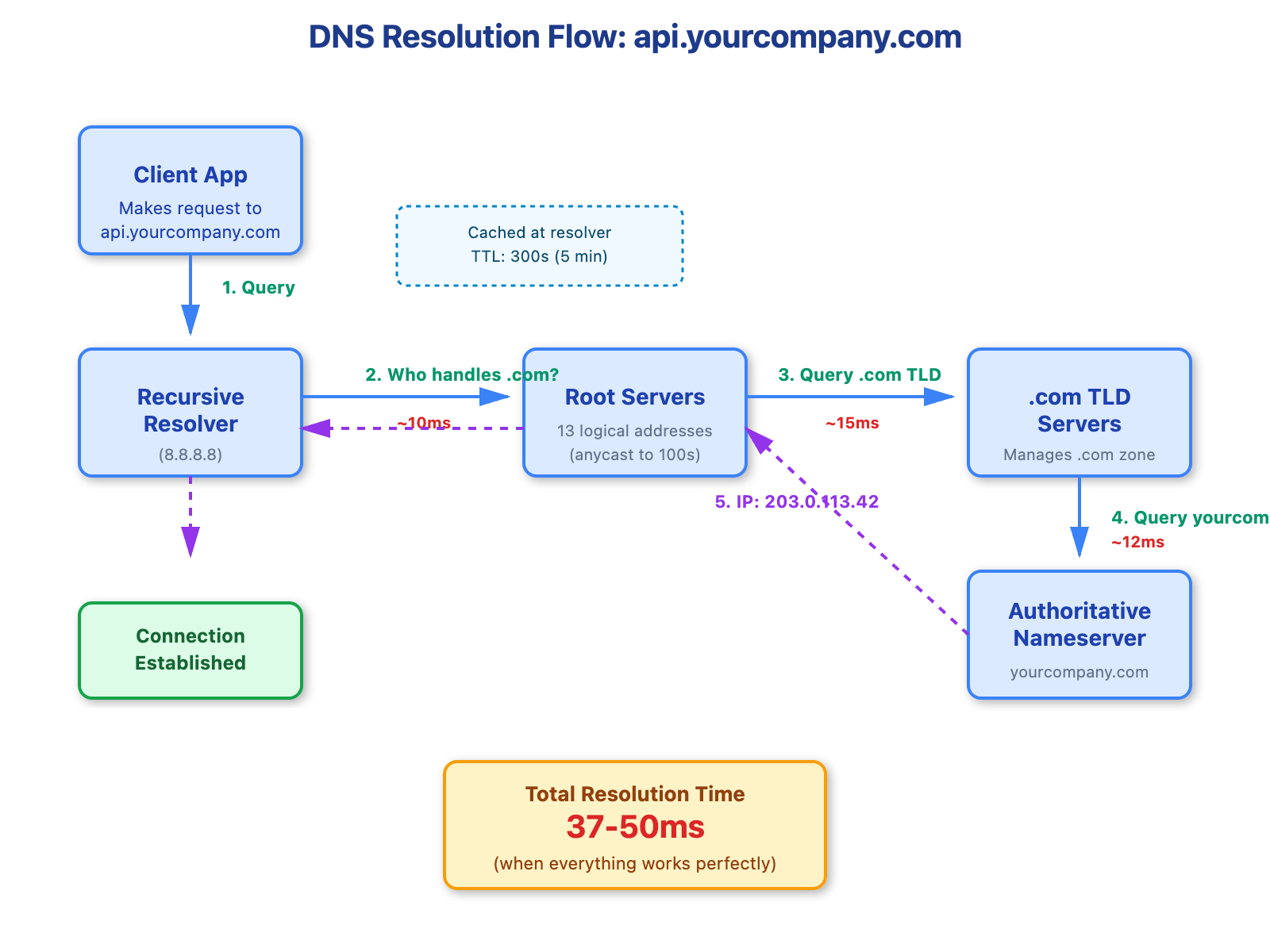
When your application looks up “api.yourcompany.com”, it’s not a simple lookup. Your recursive DNS resolver asks the root servers “who handles .com?”, then asks the .com TLD servers “who handles yourcompany.com?”, and finally asks your authoritative nameservers for the actual IP address. This chain normally completes in 20-50 milliseconds when everything works perfectly.
Normal DNS resolution showing the complete hierarchy and timing at each layer