Developing BPF Observability Tools with the Rust aya Ecosystem
PART I — The Article
Most articles about eBPF hand you a Python script wrapped around BCC or walk you through
bpftooland C skeletons, declare victory, and move on. That approach works until you need to ship a production observability tool — at which point you’re managing kernel header dependencies, fighting clang version mismatches, and hand-writing C that interacts with generated skeleton code through a layer ofvoid *casts. Theayaecosystem eliminates that entire category of problem by letting you write both the BPF kernel program and the userspace consumer in Rust, end to end, with no C in the middle.
01 — The Split You Need to Understand First
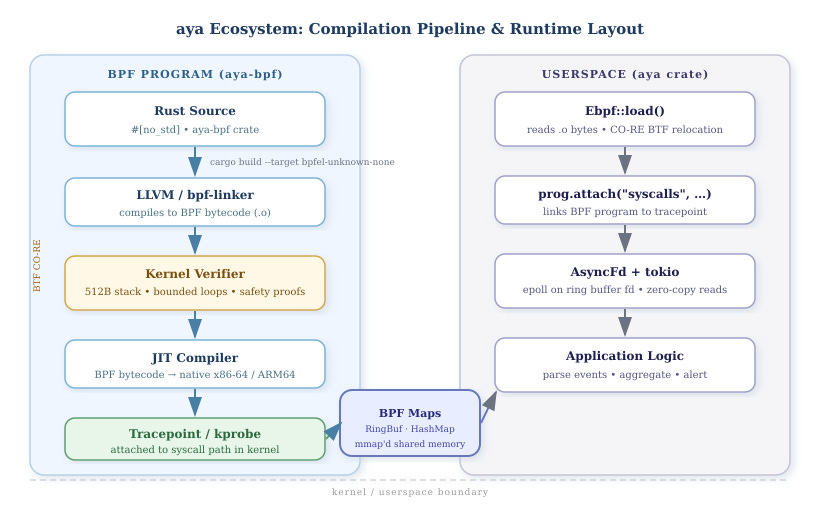
ayais not one crate. It’s two:aya-bpftargets the BPF virtual machine (bpfel-unknown-nonetriple,#[no_std]), andayais the userspace library that loads, attaches, and polls BPF programs from async Rust. The kernel-side program compiles to BPF bytecode via LLVM; the userspace binary is a normal Rust executable. They share data through BPF maps — ring buffers, hash maps, arrays — which the kernel allocates and both sides access through separate APIs.