Deploying XDP for High-Performance Load Balancing
The Linux kernel’s networking stack was not designed for 40 Gbps line rate. Every inbound packet triggers a
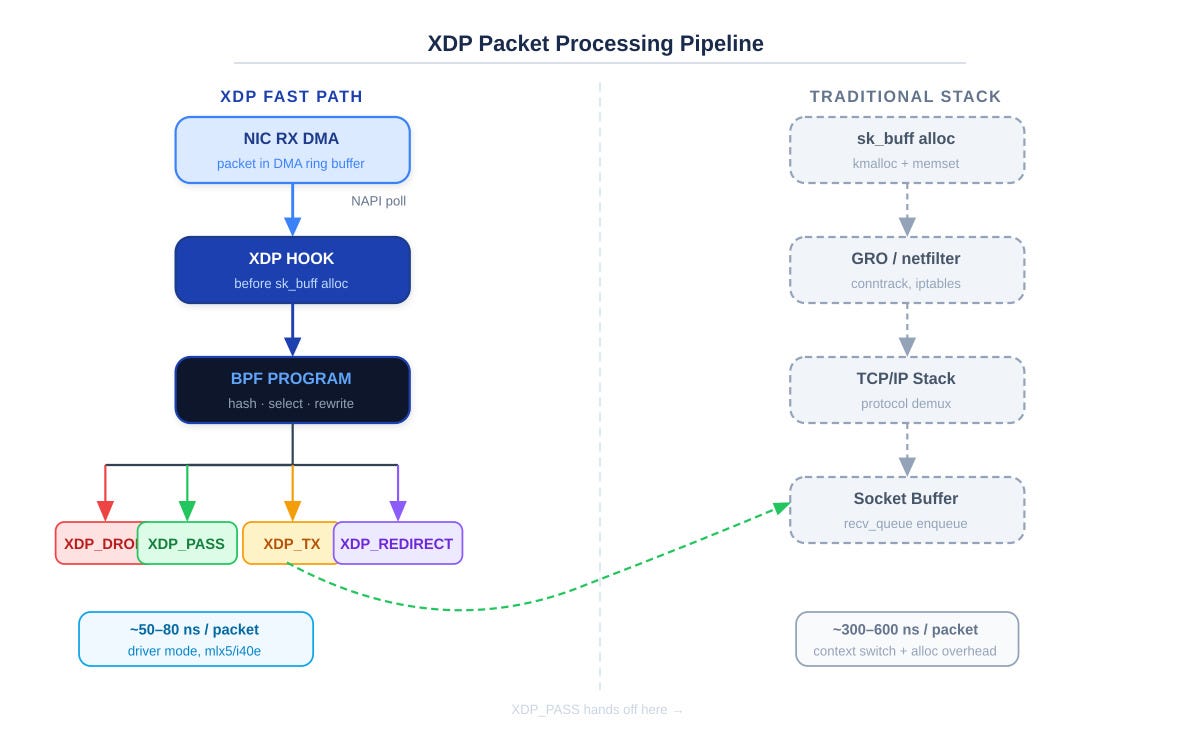
kmallocfor ansk_buff, feeds through GRO and netfilter, climbs the protocol stack, and eventually reaches your application — accumulating allocator pressure and cache misses along the way. On a modern NIC at 10 million packets per second, you have roughly 100 nanoseconds per packet. The kernel spends a significant portion of that just allocating the structure describing the packet.XDP inserts a BPF hook before
sk_buffallocation — in the NIC driver’s NAPI poll loop, operating directly on the raw DMA-mapped page. The first question any BPF program sees is the raw Ethernet frame, cache-warm from the DMA completion interrupt. No allocations. No refcounting. The difference shows up at around two to three million packets per second, where the traditional stack hits a softirq CPU ceiling and XDP has barely started.
Hook Modes and What They Actually Cost
Three XDP attachment modes exist and the difference between them is not just performance — it determines where in the packet lifecycle your program runs.
Driver mode (
XDP_FLAGS_DRV_MODE) requires explicit driver support: mlx5, i40e, ixgbe, bnxt, virtio_net, and a handful of others. The BPF program runs inside the driver’snapi_pollcallback, before any kernel structure is allocated. This is the path Facebook’s Katran and Cloudflare’s Unimog operate on, and it is the only mode worth benchmarking for production traffic shaping.Generic mode (
XDP_FLAGS_SKB_MODE) runs aftersk_buffallocation, giving XDP semantics to any interface — loopback, veth, bridge. The kernel allocates thesk_buff, strips it to find the data pointer, calls your program, then frees it if you returnXDP_DROP. You get the API without the performance. Useful for development; useless for replacing IPVS at line rate.Offload mode runs BPF on the NIC’s FPGA. Sub-nanosecond decisions, no host CPU involvement. Only Netronome Agilio supports it and the verifier restrictions are significant.