Debugging Kernel Live Lock Scenarios
Nothing teaches better than “Code in Action”.
System Design Course - Everyday code : Join Python Or Java based implementation
Learn AI Agents : Join the AI agent courses before your competition does.
Explore more hands-on courses on portal — Lifetime Access : 4 hands on courses + full portal with Pro Max offer → link
You’re staring at a production server. CPU usage is pegged at 100% across all cores. The system responds to pings. SSH works. But nothing’s actually getting done. Application throughput is zero. This isn’t a deadlock—in a deadlock, CPU usage would be near zero as threads wait. This is worse: a live lock, where everything’s running but making no forward progress.
The Live Lock Problem
Deadlock is easy to understand: thread A waits for B, B waits for A, nobody moves. Live lock is sneakier. Two threads are both active, consuming CPU, changing state—but never accomplishing anything. It’s like two people trying to pass each other in a hallway, both stepping in the same direction simultaneously, forever.
In kernel space, live locks are brutal. They burn CPU cycles, make systems look responsive, but kill throughput. Your monitoring says everything’s fine—no blocked threads, no mutex waits—until you notice requests timing out and the load average climbing past 100.
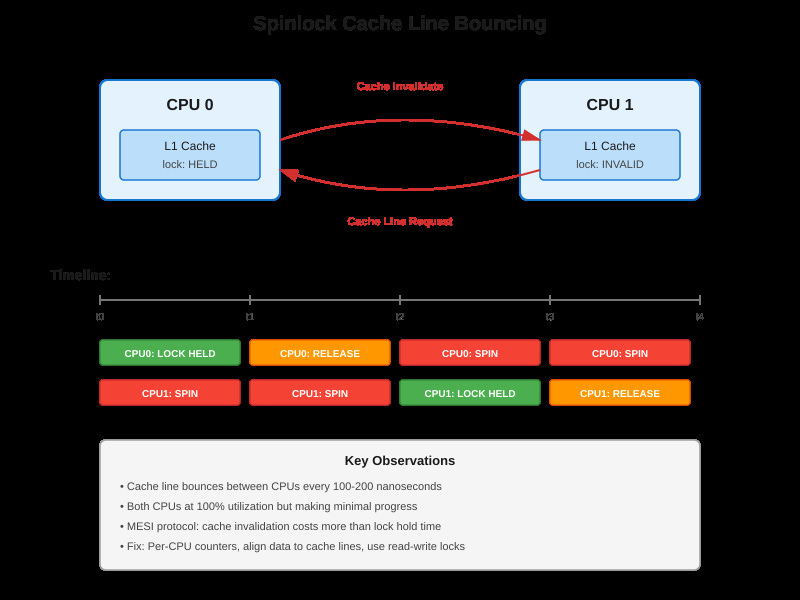
Spinlock Cache Line Bouncing
The most common kernel live lock comes from spinlock contention on modern multi-core systems. Picture this: you have a hot spinlock protecting a reference counter. Two CPUs both want to increment it. CPU 0 grabs the lock, the cache line moves to its L1 cache in exclusive state. CPU 1 spins, checking the lock variable. That check invalidates CPU 0’s cache line. CPU 0 releases the lock, takes 100 nanoseconds for cache coherency. CPU 1 sees the unlock, tries to grab it—but CPU 0 is already trying again. The cache line bounces between them. Both CPUs are at 100% utilization. Neither makes progress.